Tuesday, April 10, 2012

Deep Sea Sharks

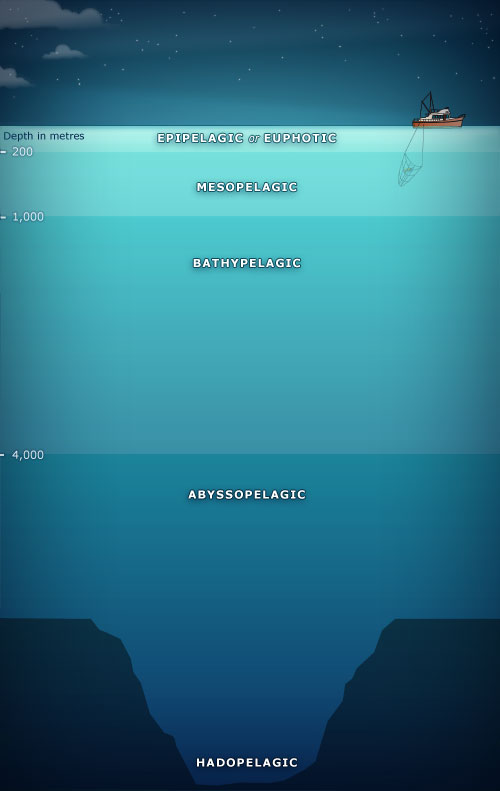
Deep sea sharks live mostly in the bathypelagic zone of the ocean. This zone, anywhere between 1,000 meters to 4,000 meters from the surface of the ocean, is completely void of any sunlight. Around 400 species of deep-sea shark have been discovered. Of those, most is known about the following three:


The shark to the right is the Bluntnose Six-gill shark, the most well known deep sea shark. This shark is dark on top to blend in with the darker ocean depths and light on the bottom to blend in with lighter tones closer to the surface. Found in tropical and temperate seas, they eat rays, bony fish, crabs, shrimp, and even seals up to 2500m below the surface.


This video above shows a rare six-gill shark sighting at 3300m.


This shark is the frilled shark, named so because of its six "frilly" gills. They have poorly-calcified skeletons and large livers filled with low-density lipids, which allows them to maintain their low position in the ocean with minimal effort. This species is one of the most primitive sharks because it hasn't evolved for thousands of years.


The shark to the right is the goblin shark, a shark that adapted to deep-sea life early in its evolutionary history. Its most distinctive characteristic is its head: it has a long trowel-shaped snout. It also has a protrusible jaw, which it sticks out when it preys on food (shown in the picture). Despite the bathypelagic zone's significantly low biomass, this shark is able to maintain its considerable mass.The video below shows the shark as it sticks out its jaws.


By Binny Kim & Kiyon Hahm

References cited:
http://dsc.discovery.com/sharks/goblin-shark.html
http://marinebio.org/spcies.asp?id=1485
http://www.arkive.org/bluntnose-six-gill-shark/hexanchus-griseus/image-G17861.html
http://www.teara.govt.nz/en/deep-sea-creatures/1/5
http://www.arkive.org/bluntnose-six-gill-shark/hexanchus-griseus/video-00.html
http://www.youtube.com/watch?v=GjRSlnJ1rA4
http://marinebio.org/species.asp?id=1485
http://www.marinebio.org/species.asp?id=88
http://www.marinebio.org/species.asp?id=234
http://www.arkive.org/bluntnose-six-gill-shark/hexanch-griseus/
http://www.elasmo-research.org/education/ecology/deepsea-goblin.htm
http://www.deepseamonsters.com/component/content/article/59-frilled-shark.html
http://www.elasmo-research.org/publications/pdfs/deep-sea-sharks.pdf


Geology, Geography, Formation, and Chemosynthesis of Hydrothermal Vents (Chrissy and Lillie)


According to http://www.ceoe.udel.edu/deepsea/level-2/geology/vents.html, hydrothermal vents contribute to the regulation of the “ocean’s temperature, chemistry, and circulation patterns,” as well as the exchange of chemicals and heat that takes place between the ocean and Earth’s interior.  In 1977, the exploration of the East Pacific Rise, a mid-ocean ridge located near the Galapagos, resulted in the discovery of hydrothermal vents.  The majority of hydrothermal vents form along mid-ocean ridges at an average depth of 2100 m, and Woods Hole Oceanographic Institute has led a recent expedition to explore several new vent sites.


At mid-ocean ridges, magma beneath the Earth’s surface forms rift valleys as it pushes the tectonic plates away from each other. When the water enters these crevices it is heated by the magma, however kept from boiling by the extreme pressure. The density of this fluid then decreases, allowing it to rise up through the vent and absorb minerals. The differences in temperature of this fluid to the water surrounding it causes it to crystallize and form chimneys that an reach up the nine feet tall.

“Black smokers” are a distinct type of hydrothermal vent that form at the location of sulfide mounds and typically emit the hottest water. The black color of the fluid emitted from these hydrothermal vents is due to the presence of the compound iron monosulfide.

The characteristics of hydrothermal vents and their communities vary based on geographic location. On the rapidly-spreading mid-ocean ridges in the Pacific, the characteristics of the vent systems appear relatively uniform; however, slow-spreading ridges have a greater degree of diversity.


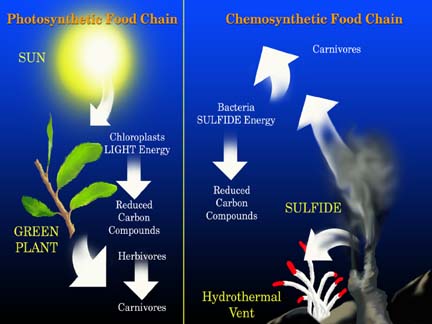
Along with heated water, minerals, and chemicals, hydrothermal vents also spew bacteria (called microbes) that play a crucial role in chemosynthesis, which is the production of food and energy from heat, chemicals (such as sulfur compounds), and methane by certain organisms.

The microbes perform chemosynthesis, releasing sulfur and water as end products while also providing a food source for larger organisms.

While black smokers release vast quantities of iron and sulfide (iron monosulfide), white smokers release colder water that contains barium, calcium, and silicon compounds.

Monday, April 9, 2012

James Wang - Squids

This squid is known as the Caribbean reef squid, or Sepioteuthis sepioidea. They have 10 arms, 8 shorter arms near the mouth and 2 longer tentacles that are tucked inside. Their eye-to-body ratio is the largest in the entire animal kingdom.

Caribbean reef squids die after they reproduce. The male will compete with other squids over a single female squid. The victor will approach the female and attempt to woo the female by stroking her with his tentacles. Once the female accepts, the male will attach a packet of sperm to the female's body.

Caribbean Reef Squid video:

Vampire squids, also known as "vampire squids from Hell," contains black chromatophores with reddish-brown chromatophores spread throughout. These chromatophores do not operate like normal squids, preventing Vampire squids from controlling color changes. Some refer to this squid as a "living fossil" because it has not changed for hundreds of millions of years.

If a Vampire squid feels endangered, it will curl its webbed tentacles over itself like a cape to protect itself. Predators will be confused and think the squid is a different species.

Vampire Squid Video:

The Vampire Squid was voted #1 as the best deep sea species. See the article at deepseanews.com

To check out more species of squids, click here.

References:
http://marinebio.org/species.asp?id=286
http://www.thecephalopodpage.org/MarineInvertebrateZoology/Sepioteuthissepioidea.html
http://marinebio.org/species.asp?id=179
http://deepseanews.com/2010/02/tgif-vampire-squid/

Hydrothermal Vents: Megafauna (Akanshu and Sara)


Figure 1 (Above): A typical hydrothermal vent.

A hydrothermal vent is, “a fissure in the ocean floor especially at or near a mid-ocean ridge from which mineral-rich superheated water issues” (4). Despite the lack of sunlight for photosynthesis, there is a rich faunal diversity near these vents. Archaebacteria which perform chemosynthesis, the conversion of chemicals into usable energy, are the base of the food chain (1). Some scientists believe that biochemistry may have originated at these vents (8). Animals here often exhibit deep-sea gigantism; a tendency for animals to become enormous, including the giant tube worm (2). To read more details about hydrothermal vents, click here.


Figure 2 (Right): Crysomallon squamiferum — the scaly-foot gastropod— is a hydrothermal vent snail that displays a unique tri-layered shell composed of iron sulfide. It captures floating iron sulfide in the water to incorporate it into its shell. This thick, protective shell serves as a defense mechanism against predators that inject venom to kill their prey (7). Scientists and engineers are studying the properties of this shell to develop better military armor (3). Click here to read more about how this iron-plated snail has inspired new armor design.


Figure 3 (Above): Located in the Pacific Ocean, Riftia pachyptila — the giant tube worm — is the fastest growing marine invertebrate, growing over 33 inches a year lengthwise. These organisms symbiotically depend on chemosynthetic bacteria as their energy source. Shrimp and crabs often nibble at these worms  (5).


Video 1 (Below):
Rimicaris exoculata (The Vent Shrimp).
Rimicaris exoculata — the vent shrimp—does not possess eyes yet exhibits a high concentration of rhodopsin (a visual pigment). These “eyespots” appear as shiny pink regions (6).


Figure 4 (Above): A microscopic hydrothermal worm.


Video 2 (Above): The NOAA ship Okeanos Explorer discovers a new vent at the Galápagos Rift.

To learn more about recently discovered species from hydrothermal vents found near Antarctica, click here.

References Cited:

  1.  MacInnis, Joseph. James Cameron’s Aliens of the Deep. Washington, D.C.: National Geographic Society, 2004. 
  2.  "The Deep Sea." MarineBio. Accessed April 2, 2012. http://marinebio.org/oceans/deep/. 
  3.   McClain, Craig. “Fool’s Gold from Hydrothermal Vents to Plankton.” Deep Sea News. Last modified  May 15, 2011. http://deepseanews.com/‌/‌/ls-gold-from-hydrothermal-vents-to-plankton/‌.    
  4.  Merriam-Webster Online, s.v. "hydrothermal vent," accessed April 2, 2012, http://www.merriam-webster.com/dictionary/hydrothermal%20vents.      
  5. Stover, Dawn. “Creatures of the Thermal Vents.” Ocean Planet Smithsonian. Accessed April 2, 2012. http://seawifs.gsfc.nasa.gov/_PLANET//_vents.html. 
  6. Zelnio, Kevin. “The ‘Eye’ of the Vent Shrimp.” Deep Sea News. Last modified  April 1, 2010. http://deepseanews.com/‌/‌/eye-of-the-vent-shrimp/‌. 
  7. Clive Thompson, "Molecular Secrets of The ‘Iron-Plated Snail’,"  Collision Detection (blog), February 2, 2010, http://www.collisiondetection.net/mt/archives/2010/02/life_isnt_easy.php.
  8. Martin, William, and Michael J. Russell. "On the Origin of Biochemistry at an Alkaline Hydrothermal Vent." Philosophical Transactions of The Royal Society 362, no. 1486 (October 2007): 1887-1926. doi:10.1098/ rstb.2006.1881.

    Tuesday, January 31, 2012

    1st Day: Marine Biology 2012! Welcome Aquanauts!

    True Blue Wonders:


    Blue Tube TV Promo Trailer:


    Gardens of the Queen of Cuba.
    Anderson Cooper, 60 Minutes:


    BBC David Attenborough's Sarcastic Fringehead:


    Tremoctopus or Blanket opctopus, Pelagoc Octopus:


    2003 Trend Report:


    Riley Shoals, Timor Sea, Northwest Australia:


    Ribbon Reefs:


    Our Blue
    Nick Stec
    Ben Hawkes:


    Jellyfish and The Giants:


    The Lion’s Mane jellyfish is the largest and longest jellyfish known and one of the longest animals in general. In 1870, a Lion’s Mane jellyfish was found washed up on the Massachusetts Bay. The bell (body) of the jellyfish had a diameter of 7 feet and 6 inches with tentacles of 120 feet.


    Flying Devil Rays on BBC:


    Deep-sea creatures at volcanic vent - video
    Camera teams have ventured deep down into the South-west Indian Ridge of the Indian Ocean to film the ecosystems surrounding 'black smokers', the volcanic underwater vents whose super-hot waters afford life to an array of weird deep-sea creatures, some of which are thought new to science, including yeti crabs and scaly-foot snails.


    Sea Grasses:


    Joe Romeiro Battle Scars:


    Diving the Ocean Voyager
    Georgia Aquarium:


    The Sea Fascinates Us!:


    How Tides Work:


    Ammonites and Trilobites:


    Elrathia kingi


    Anomalocaris had a large head, a single pair of large, compound eyes on stalks comprising approximately 16,000 individual lenses,[7][8] and an unusual, disk-like mouth. The mouth was composed of 32 overlapping plates, four large and 28 small, resembling a pineapple ring with the center replaced by a series of serrated prongs.[2] The mouth could constrict to crush prey, but never completely close, and the tooth-like prongs continued down the walls of the gullet.[9] Two large 'arms' (up to seven inches in length when extended[9]) with barb-like spikes were positioned in front of the mouth.[3]


    Plastic Shores Trailer:


    Alexis Rudd: Hawaii Institute of Marine Biology:


    Winter of Cetacean Love:


    Dad: “Every aquarium in the country says it’s hopeless. No dolphin has ever lost a tail and SURVIVED!”
    Sawyer: “Well they haven’t met Winter”
    “We’re here because of the most amazing friend and animal I’ve ever known…Winter and I are family now. And family is forever”
    “That dolphin’s taking us somwhere-we just haven’t figured out where yet”
    “I thought dolphins were supposed to be smart. Don’t you understand? If you don’t get the tail your’e going to die. Why won’t you just wear the tail??” (Sawyer speaking to Winter in a sad breathy whisper)


    Clearwater Marine Aquarium:


    Kevin's "I am Science" Put On Video by "Mindy":

    I Am Science from Mindy Weisberger on Vimeo.

    Tuesday, January 3, 2012

    Indian Ocean Creatures from Deep Sea Vent

    Photos From The Guardian: Indian Ocean Vent Critters

    Indian Ocean Video Link

    British scientists have found a remarkable array of creatures, some of them new to science, in one of the most inhospitable regions of the deep sea. In the first ever expedition to explore and take samples from the "Dragon Vent" in the south-west Indian Ocean, remotely operated submarines spotted yeti crabs, sea cucumbers and snails living around the boiling column of mineral-rich water that spews out of the seafloor.

    Dr Jon Copley, a marine biologist at the University of Southampton who led the exploration of the Dragon Vent, said his team found animals that had not been seen in neighbouring parts of the oceans.

    "We found a new type of yeti crab. Yeti crabs are known at vents in the eastern Pacific and there are two species described so far, but they have very long, hairy arms – ours have short arms and their undersides are covered in bristles. They're quite different to the ones that are known from the Pacific," said Copley. "This is the first time a Yeti crab has been seen in the Indian Ocean."

    His team also found sea cucumbers, vent shrimps and scaly-foot snails. Sea cucumbers have previously only been seen at deep sea vents in the eastern Pacific. "This is the first time they've been seen at vents in the Indian Ocean and they're not known from the central Indian or mid-Atlantic vents so far," he said.

    Deep-sea vents, also known as hydrothermal vents, are springs of superheated water that are powered by underwater volcanoes. They erupt from the sea bed and are usually found a few miles under the sea surface. The scalding temperatures and rich mineral content of the water give rise to vast rocky chimneys, which have been found to support a wide variety of life forms.

    The survey was part of a larger expedition to study underwater mountains aboard the RRS James Cook, which sailed from Cape Town on 7 November and returned to South Africa on 21 December. The exploration of the Dragon Vent took place in an intense three-day burst in the middle of the trip.

    Copley's team took hundreds of samples of 17 different creatures, all of which are now being shipped back to his lab for detailed morphological and genetic examination. "Chances are that there will be several that are new species," he said. "We won't know for sure until we get them back into the lab and analyse them."

    Copley's work builds on a Chinese expedition in 2007 that pinpointed the hydrothermal vents on the southwest Indian ridge for the first time. This chain of undersea volcanoes joins the mid-Atlantic ridge to the central Indian ridge. This part of the volcanic ridge is less volcanically active, so scientists think hydrothermal vents should be fewer and more scattered here. It therefore raises the question of whether life there is significantly different.

    Copley said that characterising the life at the world's hydrothermal vents was a race against time. "Earlier this year, China was granted a licence by the UN International Seabed Authority for exploratory mining at deep-sea vents on the southwest Indian ridge," he said. "The vent chimneys are very rich in copper, zinc, gold and uranium. But we have no idea what's actually living there."

    In evolutionary terms, hydrothermal vents were like the islands of the ocean floor, he added. "Just like the 19th century naturalists used to go to the Galápagos and other islands to find species there that are different to elsewhere and then use that to understand patterns of dispersal of dispersal and evolution, we can use deep-sea vents to do the same things beneath the waves," he said.

    "And we need to do that because the exploitation of the deep ocean is overtaking its exploration. We're fishing in deeper and deeper waters, oil and gas is moving into deeper waters and now there's mining starting to take place in deep waters. We need to understand how species disperse and evolve in the deep oceans if we're going to make responsible decisions about managing their resources."

    Tuesday, December 27, 2011

    True Blue

    Brian Skerry's Description of Right Whale Encounter:


    2012 Tribute to Jacques Cousteau:


    2012 Joe Romeiro White Shark:


    BBC's Earth Flight New Series:


    Randy Jordan of Emerald Charters found an airplane in 180 feet of water off Palm Beach Florida:


    Experts there told Jordan that the submerged aircraft could be a Curtiss Helldiver SBC2. Some of those airplanes flew in the early 1940s during World War II.

    So here we are. At the finish line. 10 month in the making. 7 minutes long. It has taken hundred of dives and thousands of takes. It has cost us a small fortune and most of our sanity. But it is done. We hope you enjoy it. We hope you get behind us. There is much yet to do. Please share it and please buy it. Sing it far and wide. This is our chance to sing for our oceans. The proceeds from the sale of the song will be given to the organisations shown @ 5:40.


    From Blue Tube TV:

    The ocean makes life on Earth possible, and it needs our help. Most people don't realize the long list of benefits the ocean provides us, nor how much we are connected and dependent on it. Just to name a few things; the ocean produces 70 to 80% of the oxygen we breath, generates $21 trillion in ecosystem services each year, and provides the main source of protein for 1/4 of the world's population. And these are just a few of the amazing functions it offers this planet's 6+billion people. In the past 50 years the health of the ocean has declined dramatically due to the major 5. That's right, the major 5, There are five serious threats that are causing this havoc; over fishing, pollution, invasive species, habitat destruction, and climate change. Actions must be taken to address these problems in order for the ocean to recover and become healthy once again. Come explore the ocean with us and find out how you can help.


    Blue Tube TV Promo Trailer:

    Plastic Shores Trailer

    Plastic Shores Trailer

    A non-profit educational film about the effects of plastic debris on our marine ecosystem.
    In the year 2010 global plastic production reached 300 million tonnes. A third of this was used in disposable packaging. In the United Kingdom, 3 million tonnes of plastic are thrown away every year, 1% of the total amount of all plastic manufactured on the planet.
    But what happens to this plastic when it is thrown away? Most of it makes its way to landfill. Some goes to recycling or incineration. The rest escapes into our environment, and to the world's oceans…and nobody knows how long it will stay there. Estimates range from decades to hundreds of thousands of years.
    'Plastic Shores' is a documentary that explores how plastic affects the marine environment. Travelling from the International Marine Debris Conference in Hawai'i to the polluted Blue Flag beaches of Cornwall, the film reveals just how bad the problem of plastic debris is and how it harms aquatic life. There is now not a single beach or sea in the world that is not affected by plastic pollution and the problem is only increasing.
    Plastic Shores will be released mid-2012.

    60 Minutes

    Anderson Cooper on 60 Minutes:
    Anderson Cooper takes viewers on an underwater adventure to one of the world's most vibrant coral reefs, an anomaly at a time when many of the world's reefs are in danger - or already dead.

    Read more: http://www.cbsnews.com/video/watch/?id=7392092n#ixzz1hlUCIdpG