Tuesday, April 10, 2012

Deep Sea Sharks

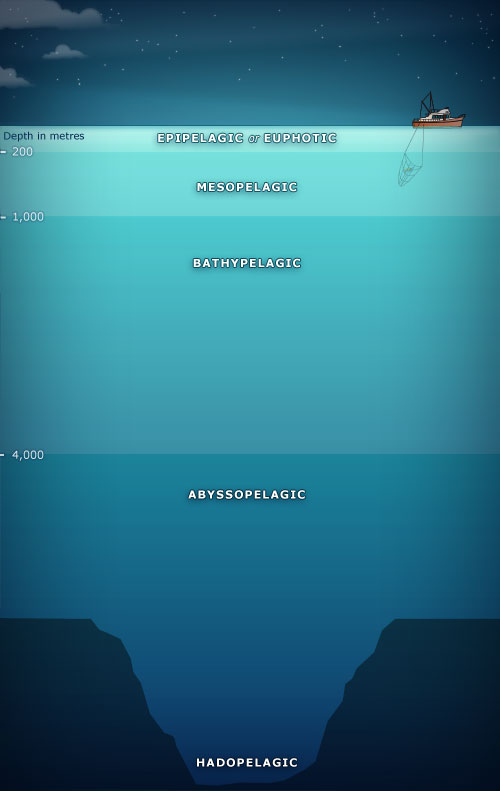
Deep sea sharks live mostly in the bathypelagic zone of the ocean. This zone, anywhere between 1,000 meters to 4,000 meters from the surface of the ocean, is completely void of any sunlight. Around 400 species of deep-sea shark have been discovered. Of those, most is known about the following three:


The shark to the right is the Bluntnose Six-gill shark, the most well known deep sea shark. This shark is dark on top to blend in with the darker ocean depths and light on the bottom to blend in with lighter tones closer to the surface. Found in tropical and temperate seas, they eat rays, bony fish, crabs, shrimp, and even seals up to 2500m below the surface.


This video above shows a rare six-gill shark sighting at 3300m.


This shark is the frilled shark, named so because of its six "frilly" gills. They have poorly-calcified skeletons and large livers filled with low-density lipids, which allows them to maintain their low position in the ocean with minimal effort. This species is one of the most primitive sharks because it hasn't evolved for thousands of years.


The shark to the right is the goblin shark, a shark that adapted to deep-sea life early in its evolutionary history. Its most distinctive characteristic is its head: it has a long trowel-shaped snout. It also has a protrusible jaw, which it sticks out when it preys on food (shown in the picture). Despite the bathypelagic zone's significantly low biomass, this shark is able to maintain its considerable mass.The video below shows the shark as it sticks out its jaws.


By Binny Kim & Kiyon Hahm

References cited:
http://dsc.discovery.com/sharks/goblin-shark.html
http://marinebio.org/spcies.asp?id=1485
http://www.arkive.org/bluntnose-six-gill-shark/hexanchus-griseus/image-G17861.html
http://www.teara.govt.nz/en/deep-sea-creatures/1/5
http://www.arkive.org/bluntnose-six-gill-shark/hexanchus-griseus/video-00.html
http://www.youtube.com/watch?v=GjRSlnJ1rA4
http://marinebio.org/species.asp?id=1485
http://www.marinebio.org/species.asp?id=88
http://www.marinebio.org/species.asp?id=234
http://www.arkive.org/bluntnose-six-gill-shark/hexanch-griseus/
http://www.elasmo-research.org/education/ecology/deepsea-goblin.htm
http://www.deepseamonsters.com/component/content/article/59-frilled-shark.html
http://www.elasmo-research.org/publications/pdfs/deep-sea-sharks.pdf


Geology, Geography, Formation, and Chemosynthesis of Hydrothermal Vents (Chrissy and Lillie)


According to http://www.ceoe.udel.edu/deepsea/level-2/geology/vents.html, hydrothermal vents contribute to the regulation of the “ocean’s temperature, chemistry, and circulation patterns,” as well as the exchange of chemicals and heat that takes place between the ocean and Earth’s interior.  In 1977, the exploration of the East Pacific Rise, a mid-ocean ridge located near the Galapagos, resulted in the discovery of hydrothermal vents.  The majority of hydrothermal vents form along mid-ocean ridges at an average depth of 2100 m, and Woods Hole Oceanographic Institute has led a recent expedition to explore several new vent sites.


At mid-ocean ridges, magma beneath the Earth’s surface forms rift valleys as it pushes the tectonic plates away from each other. When the water enters these crevices it is heated by the magma, however kept from boiling by the extreme pressure. The density of this fluid then decreases, allowing it to rise up through the vent and absorb minerals. The differences in temperature of this fluid to the water surrounding it causes it to crystallize and form chimneys that an reach up the nine feet tall.

“Black smokers” are a distinct type of hydrothermal vent that form at the location of sulfide mounds and typically emit the hottest water. The black color of the fluid emitted from these hydrothermal vents is due to the presence of the compound iron monosulfide.

The characteristics of hydrothermal vents and their communities vary based on geographic location. On the rapidly-spreading mid-ocean ridges in the Pacific, the characteristics of the vent systems appear relatively uniform; however, slow-spreading ridges have a greater degree of diversity.


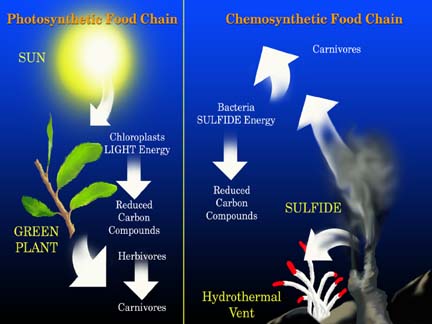
Along with heated water, minerals, and chemicals, hydrothermal vents also spew bacteria (called microbes) that play a crucial role in chemosynthesis, which is the production of food and energy from heat, chemicals (such as sulfur compounds), and methane by certain organisms.

The microbes perform chemosynthesis, releasing sulfur and water as end products while also providing a food source for larger organisms.

While black smokers release vast quantities of iron and sulfide (iron monosulfide), white smokers release colder water that contains barium, calcium, and silicon compounds.

Monday, April 9, 2012

James Wang - Squids

This squid is known as the Caribbean reef squid, or Sepioteuthis sepioidea. They have 10 arms, 8 shorter arms near the mouth and 2 longer tentacles that are tucked inside. Their eye-to-body ratio is the largest in the entire animal kingdom.

Caribbean reef squids die after they reproduce. The male will compete with other squids over a single female squid. The victor will approach the female and attempt to woo the female by stroking her with his tentacles. Once the female accepts, the male will attach a packet of sperm to the female's body.

Caribbean Reef Squid video:

Vampire squids, also known as "vampire squids from Hell," contains black chromatophores with reddish-brown chromatophores spread throughout. These chromatophores do not operate like normal squids, preventing Vampire squids from controlling color changes. Some refer to this squid as a "living fossil" because it has not changed for hundreds of millions of years.

If a Vampire squid feels endangered, it will curl its webbed tentacles over itself like a cape to protect itself. Predators will be confused and think the squid is a different species.

Vampire Squid Video:

The Vampire Squid was voted #1 as the best deep sea species. See the article at deepseanews.com

To check out more species of squids, click here.

References:
http://marinebio.org/species.asp?id=286
http://www.thecephalopodpage.org/MarineInvertebrateZoology/Sepioteuthissepioidea.html
http://marinebio.org/species.asp?id=179
http://deepseanews.com/2010/02/tgif-vampire-squid/

Hydrothermal Vents: Megafauna (Akanshu and Sara)


Figure 1 (Above): A typical hydrothermal vent.

A hydrothermal vent is, “a fissure in the ocean floor especially at or near a mid-ocean ridge from which mineral-rich superheated water issues” (4). Despite the lack of sunlight for photosynthesis, there is a rich faunal diversity near these vents. Archaebacteria which perform chemosynthesis, the conversion of chemicals into usable energy, are the base of the food chain (1). Some scientists believe that biochemistry may have originated at these vents (8). Animals here often exhibit deep-sea gigantism; a tendency for animals to become enormous, including the giant tube worm (2). To read more details about hydrothermal vents, click here.


Figure 2 (Right): Crysomallon squamiferum — the scaly-foot gastropod— is a hydrothermal vent snail that displays a unique tri-layered shell composed of iron sulfide. It captures floating iron sulfide in the water to incorporate it into its shell. This thick, protective shell serves as a defense mechanism against predators that inject venom to kill their prey (7). Scientists and engineers are studying the properties of this shell to develop better military armor (3). Click here to read more about how this iron-plated snail has inspired new armor design.


Figure 3 (Above): Located in the Pacific Ocean, Riftia pachyptila — the giant tube worm — is the fastest growing marine invertebrate, growing over 33 inches a year lengthwise. These organisms symbiotically depend on chemosynthetic bacteria as their energy source. Shrimp and crabs often nibble at these worms  (5).


Video 1 (Below):
Rimicaris exoculata (The Vent Shrimp).
Rimicaris exoculata — the vent shrimp—does not possess eyes yet exhibits a high concentration of rhodopsin (a visual pigment). These “eyespots” appear as shiny pink regions (6).


Figure 4 (Above): A microscopic hydrothermal worm.


Video 2 (Above): The NOAA ship Okeanos Explorer discovers a new vent at the Galápagos Rift.

To learn more about recently discovered species from hydrothermal vents found near Antarctica, click here.

References Cited:

  1.  MacInnis, Joseph. James Cameron’s Aliens of the Deep. Washington, D.C.: National Geographic Society, 2004. 
  2.  "The Deep Sea." MarineBio. Accessed April 2, 2012. http://marinebio.org/oceans/deep/. 
  3.   McClain, Craig. “Fool’s Gold from Hydrothermal Vents to Plankton.” Deep Sea News. Last modified  May 15, 2011. http://deepseanews.com/‌/‌/ls-gold-from-hydrothermal-vents-to-plankton/‌.    
  4.  Merriam-Webster Online, s.v. "hydrothermal vent," accessed April 2, 2012, http://www.merriam-webster.com/dictionary/hydrothermal%20vents.      
  5. Stover, Dawn. “Creatures of the Thermal Vents.” Ocean Planet Smithsonian. Accessed April 2, 2012. http://seawifs.gsfc.nasa.gov/_PLANET//_vents.html. 
  6. Zelnio, Kevin. “The ‘Eye’ of the Vent Shrimp.” Deep Sea News. Last modified  April 1, 2010. http://deepseanews.com/‌/‌/eye-of-the-vent-shrimp/
  7. Clive Thompson, "Molecular Secrets of The ‘Iron-Plated Snail’,"  Collision Detection (blog), February 2, 2010, http://www.collisiondetection.net/mt/archives/2010/02/life_isnt_easy.php.
  8. Martin, William, and Michael J. Russell. "On the Origin of Biochemistry at an Alkaline Hydrothermal Vent." Philosophical Transactions of The Royal Society 362, no. 1486 (October 2007): 1887-1926. doi:10.1098/ rstb.2006.1881.

    Tuesday, January 31, 2012

    1st Day: Marine Biology 2012! Welcome Aquanauts!

    True Blue Wonders:


    Blue Tube TV Promo Trailer:


    Gardens of the Queen of Cuba.
    Anderson Cooper, 60 Minutes:


    BBC David Attenborough's Sarcastic Fringehead:


    Tremoctopus or Blanket opctopus, Pelagoc Octopus:


    2003 Trend Report:


    Riley Shoals, Timor Sea, Northwest Australia:


    Ribbon Reefs:


    Our Blue
    Nick Stec
    Ben Hawkes:


    Jellyfish and The Giants:


    The Lion’s Mane jellyfish is the largest and longest jellyfish known and one of the longest animals in general. In 1870, a Lion’s Mane jellyfish was found washed up on the Massachusetts Bay. The bell (body) of the jellyfish had a diameter of 7 feet and 6 inches with tentacles of 120 feet.


    Flying Devil Rays on BBC:


    Deep-sea creatures at volcanic vent - video
    Camera teams have ventured deep down into the South-west Indian Ridge of the Indian Ocean to film the ecosystems surrounding 'black smokers', the volcanic underwater vents whose super-hot waters afford life to an array of weird deep-sea creatures, some of which are thought new to science, including yeti crabs and scaly-foot snails.


    Sea Grasses:


    Joe Romeiro Battle Scars:


    Diving the Ocean Voyager
    Georgia Aquarium:


    The Sea Fascinates Us!:


    How Tides Work:


    Ammonites and Trilobites:


    Elrathia kingi


    Anomalocaris had a large head, a single pair of large, compound eyes on stalks comprising approximately 16,000 individual lenses,[7][8] and an unusual, disk-like mouth. The mouth was composed of 32 overlapping plates, four large and 28 small, resembling a pineapple ring with the center replaced by a series of serrated prongs.[2] The mouth could constrict to crush prey, but never completely close, and the tooth-like prongs continued down the walls of the gullet.[9] Two large 'arms' (up to seven inches in length when extended[9]) with barb-like spikes were positioned in front of the mouth.[3]


    Plastic Shores Trailer:


    Alexis Rudd: Hawaii Institute of Marine Biology:


    Winter of Cetacean Love:


    Dad: “Every aquarium in the country says it’s hopeless. No dolphin has ever lost a tail and SURVIVED!”
    Sawyer: “Well they haven’t met Winter”
    “We’re here because of the most amazing friend and animal I’ve ever known…Winter and I are family now. And family is forever”
    “That dolphin’s taking us somwhere-we just haven’t figured out where yet”
    “I thought dolphins were supposed to be smart. Don’t you understand? If you don’t get the tail your’e going to die. Why won’t you just wear the tail??” (Sawyer speaking to Winter in a sad breathy whisper)


    Clearwater Marine Aquarium:


    Kevin's "I am Science" Put On Video by "Mindy":

    I Am Science from Mindy Weisberger on Vimeo.